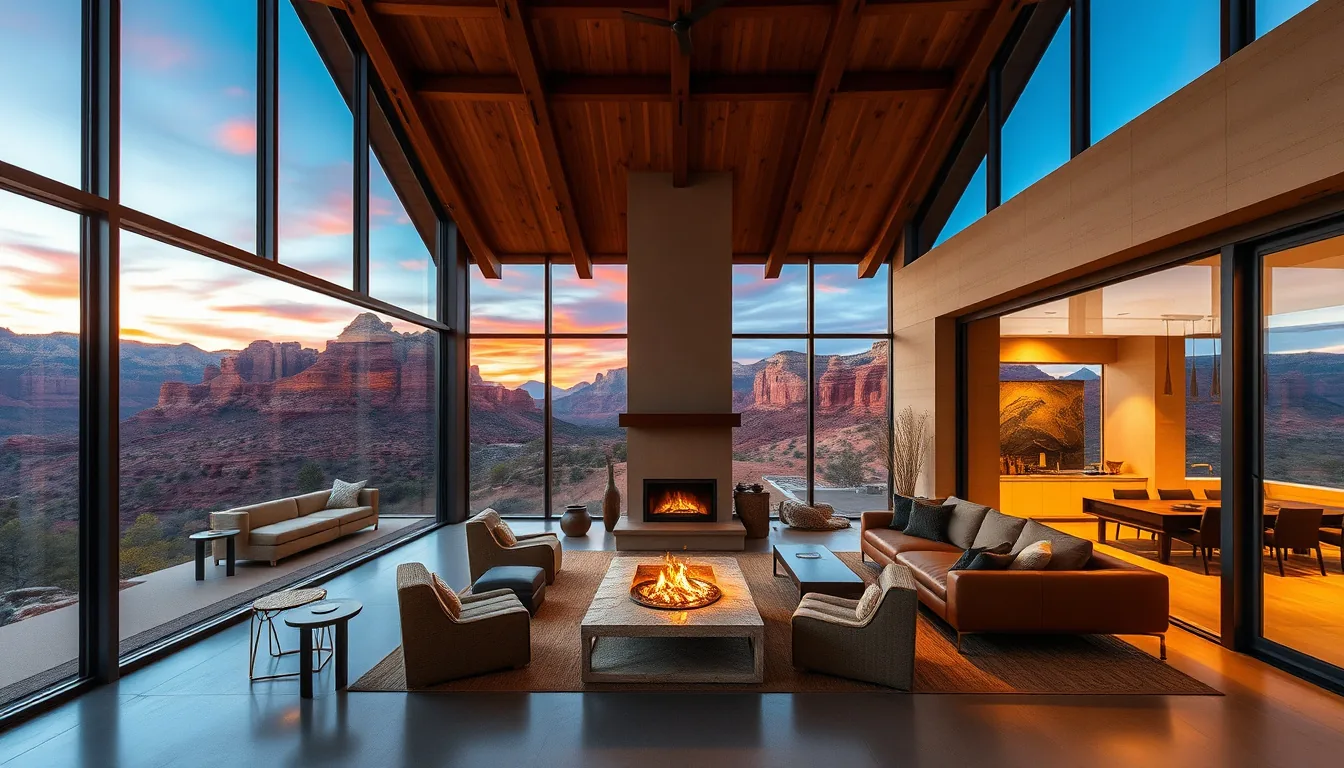
High-Value Home — Sedona, AZ
High-Value Home Insurance for Sedona's Red-Rock Luxury Homes
With a median sale price around $1.25 million and $515 per square foot, most Sedona homes are high-value homes. The question is whether your policy was written like it knows that.
In Sedona, 'normal' homes are high-value homes
Sedona's median single-family sale price hit roughly $1.25 million in mid-2026 — about $515 per square foot, with view corridors and Oak Creek frontage commanding far more. At those numbers, the standard HO-3 policy and its default replacement-cost calculator are quietly wrong for a large share of the housing stock in Sedona, Oak Creek Canyon, and the Village of Oak Creek.
High-value home insurance isn't a marketing tier — it's a structurally different contract: broader valuation language, higher sub-limits, dedicated claims teams, and wildfire services that standard carriers simply don't offer. If your home would cost more than a million dollars to rebuild, this is the market you should be quoted in.
Where standard policies fail luxury homes
The failure points are predictable. Default calculators miss custom architecture. Sub-limits cap jewelry, art, and wine far below what owners actually hold. And after a regional disaster, demand surge pushes rebuild costs 20–40% past the estimate the policy was priced on.
- Extended or guaranteed replacement cost — the single most important upgrade for a custom home
- Cash-settlement options: take the money and buy elsewhere instead of rebuilding
- Scheduled valuables: art, jewelry, collectibles at agreed value with no deductible
- Full water-damage and backup coverage rather than trimmed sub-limits
- Higher liability limits that pair cleanly with a personal umbrella
Custom features carriers must actually account for
Sedona's signature architecture — glass walls framing Cathedral Rock, radiant floors, viga-beam ceilings, custom masonry, infinity-edge pools on slope lots — is exactly what generic replacement calculators can't see. A proper high-value policy starts with a genuine appraisal-grade replacement estimate, often including an in-person inspection by the carrier.
Rebuild timelines matter too. Sedona's design review, dark-sky lighting compliance, and a thin local contractor pool make rebuilds slower and costlier than carrier defaults assume. Guaranteed replacement cost plus generous additional living expense keeps a two-year custom rebuild from becoming your out-of-pocket problem.
Wildfire services only premium carriers offer
The high-net-worth carriers — the Chubb, PURE, and Cincinnati class of market — do something in wildfire country that standard carriers don't: they intervene before the fire arrives. Enrolled homes get private wildfire-defense services that pre-treat with retardant, clear gutters and combustibles, and station resources during active fires.
For homes backing the Coconino National Forest — precisely the perimeter properties seeing non-renewals after the Slide, Rafael, and 2026 Pocket fires — those services are often the difference between insurable and not. Add defensible-space credits and Firewise USA recognition, and premium-market pricing frequently lands closer to standard-market pricing than owners expect.
Second homes and seasonal occupancy — written correctly
A large share of Sedona's luxury homes are second homes that sit empty part of the year, and occupancy is a core underwriting question. Extended vacancy on a policy written as 'primary occupied' can suspend key coverages exactly when a slow water leak or a break-in happens.
We write seasonal and secondary occupancy accurately, then engineer the discounts back: monitored water-shutoff systems, central station alarms, low-temperature sensors, and a local property manager listed on the file. Done right, a second home is a routine placement rather than a coverage gap wearing a beautiful facade.
Canyon-edge homes: premium market or surplus lines
Some Sedona homes carry wildfire scores that even high-net-worth carriers decline — canyon-edge lots, single-access roads, heavy fuel loads. Because Arizona has no FAIR Plan, the fallback for those homes is the surplus-lines market, where terms and pricing vary enormously between carriers.
This is where independent access earns its keep. We quote the premium admitted market first, and when a home needs E&S placement we negotiate terms — wildfire deductibles, mitigation credits, valuation language — instead of accepting the first quote a wholesaler returns. And we build the file that moves you back to the admitted market when conditions allow.
Pair it with an umbrella — wealth needs liability depth
A high-value home usually signals high-value assets, and liability claims target assets. Guests injured on a view deck, a pool incident, a dog bite, a serious auto accident — verdicts routinely clear the liability limits on even a generous home policy.
A personal umbrella adds $1 million to $10 million of liability above your home, auto, and any landlord or STR policies, typically for a few hundred dollars per million per year. For most Sedona high-value households it's the cheapest meaningful protection on the entire insurance program.
A confidential, appraisal-grade quote process
High-value quoting is discreet and document-driven: square footage and finish detail, roof and systems ages, mitigation work, occupancy pattern, and schedules for valuables. With a current declarations page we'll produce a line-by-line comparison showing exactly where a premium carrier outperforms your current policy — and where it doesn't.
Call 844-967-5247 or start the quote form. We place high-value homes across Sedona, Oak Creek Canyon, the Village of Oak Creek, and the wider Verde Valley.
High-Value Home Insurance FAQs
Common questions from Verde Valley clients
As a rule of thumb, any home with a rebuild cost above roughly $750,000 to $1 million benefits from the high-value market — which at Sedona's ~$515 per square foot covers much of the local housing stock, especially custom and view properties.
Custom architecture, glass walls, specialty roofs, and remote or steep lots raise rebuild cost and wildfire exposure at the same time. High-net-worth carriers respond with guaranteed replacement cost, cash-out options, and private wildfire-defense services — often worth more than their premium difference.
Yes. Seasonal and secondary homes need a policy written for that occupancy — extended vacancy can suspend key coverages on a standard policy. We place these routinely, often adding water-leak sensors and monitoring to qualify for better terms.
Very possibly. Wildfire demand surge plus Sedona's design-review and dark-sky constraints push rebuild costs well above normal estimates. We recommend a replacement-cost review at every renewal, plus inflation guard and 25–50% extended replacement cost.
Ready to compare high-value home options?
One conversation, multiple carriers compared — including the specialty markets that write red-rock country.