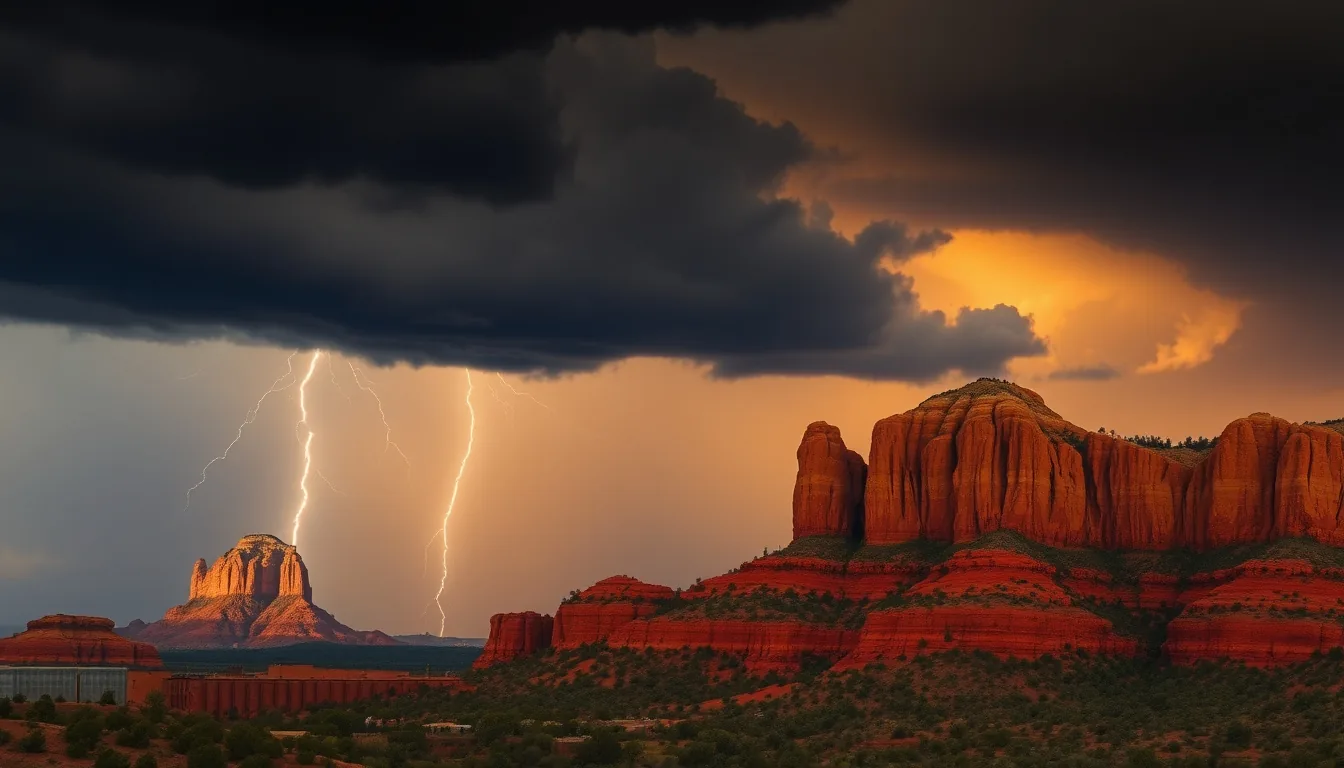
Sedona insurance questions, answered straight
28 real questions from Verde Valley homeowners, hosts, and business owners — wildfire to monsoon to the fine print.
Wildfire & Home Insurance
The questions that dominate every Sedona homeowner conversation since the Slide, Rafael, and Pocket fires.
Yes. Wildfire Risk to Communities rates Sedona's risk higher than 95% of U.S. communities, and First Street's model puts essentially all local properties at some wildfire risk over 30 years. Carriers score homes individually — proximity to the Coconino National Forest boundary, slope, and vegetation drive your rate more than your ZIP code.
The Slide Fire (May 2014) burned 21,227 acres in Oak Creek Canyon; the Rafael Fire (June 2021) burned roughly 78,000 acres west of Sedona; and the Pocket Fire (June 2026) burned about 26,400 acres seven miles north of town, forcing GO evacuations of Oak Creek Canyon and closing SR 89A. Wildfire here is a recurring event, not a hypothetical.
Don't panic and don't let coverage lapse — a lapse makes replacement harder. As an independent agency we re-shop admitted carriers first, then specialty and surplus-lines markets that write WUI homes; documenting defensible space and mitigation (a Fire Safe Sedona assessment helps) often flips a declination. Arizona non-renewal rates are still low statewide — about 0.8% in 2023 — but concentrated in wildfire pockets like ours.
No — Arizona has no FAIR Plan or state-backed insurer of last resort. If standard carriers decline your home, the fallback is the surplus-lines (excess & surplus) market, which typically costs 20–50% more with narrower terms. That's exactly why working with an independent agent who has E&S access matters in Sedona.
It can help with both availability and price. Sedona launched a program in 2026 to get subdivisions Firewise-certified, and Canyon Mesa Country Club earned recognition after residents saw wildfire-related cancellations. Several carriers give credits for Firewise membership or will write homes in recognized communities they'd otherwise decline.
Generally yes, through Additional Living Expense (loss of use) coverage — but most policies require a mandatory civil-authority evacuation order, and coverage is time-limited. During the June 2026 Pocket Fire GO orders, ALE would cover hotel, meals, and pet boarding above normal living costs. Keep receipts for everything.
Short-Term Rentals
Sedona has roughly 1,100 permitted STRs — these are the rules and coverage realities behind them.
Sedona's STR permit (City Code Ch. 5.25) requires proof of liability insurance of at least $500,000 in aggregate per rental unit, plus a state TPT license, an annual $210-per-unit permit fee, a designated emergency contact, and notification of neighboring properties. We issue city-compliant certificates as part of writing the policy.
No. Arizona's SB1350 (2016) preempts cities from banning STRs; SB1168 (2022) lets cities require permits and impose health-and-safety rules, which is what Sedona's permit program does. STRs are legal in Sedona — but they must be permitted, taxed, and insured.
Almost never. Homeowners policies exclude business use, and renting to paying guests is a business — a guest injury or guest-caused fire can be denied entirely. You need a dedicated STR policy that covers guest liability, guest-caused damage, and lost rental income.
No — AirCover and Vrbo's programs are host-protection arrangements, not insurance policies you own. They have significant exclusions and pay at the platform's discretion. Treat them as a backstop, never your primary coverage.
As of early 2025 the city counted roughly 1,116 short-term rentals — about 16% of Sedona's housing units, up from roughly 400 in 2020 — and about two-thirds are owned by people who live outside Sedona. That's why STR insurance is a core service line for us, not a niche.
Monsoon & Flood
Monsoon season runs mid-June through September — and the flood exclusion surprises someone every year.
Wind, hail, lightning, and rain entering through storm-created openings are covered perils on standard policies — so a monsoon-torn roof and the resulting interior damage are typically covered, subject to your wind/hail deductible. Surface water flooding is the big exception.
No. Flood — rising surface water, flash floods, debris flow — is excluded from every standard homeowners policy. You need a separate flood policy through the NFIP or a private flood carrier; NFIP policies carry a 30-day waiting period, so buy before monsoon season, not during it.
Often yes — a quarter or more of NFIP claims nationally come from outside high-risk zones, and post-wildfire burn scars dramatically change runoff. After the 2026 Pocket Fire, the NWS issued flash-flood warnings for the burn scar affecting Oak Creek Canyon and Sedona. Outside high-risk zones, pricing is relatively cheap.
Yes. FEMA, Yavapai and Coconino counties, and the City of Sedona completed a multi-year Oak Creek remapping: new Flood Insurance Rate Maps took effect March 21, 2023 for the Coconino County portion and February 8, 2024 for the Yavapai County portion. Some properties moved into — or out of — mapped flood hazard areas.
After a fire strips vegetation, even modest monsoon rain can send water, ash, rock, and mud down canyons — the classic burn-scar hazard below Oak Creek Canyon. Insurers treat mudflow as flood, so it's excluded from homeowners policies but covered under NFIP flood policies.
Home Values & High-Value Homes
With a $1.25M median sale price, most Sedona homes need more than a default policy.
The median single-family sale price in Sedona was about $1.25M in mid-2026, around $515 per square foot. At those replacement costs, default carrier calculators frequently underinsure — we insure to rebuild cost, not market price, and add extended replacement cost.
Custom architecture, glass walls, specialty roofs, and remote or steep lots raise rebuild costs and wildfire exposure simultaneously. High-net-worth carriers add guaranteed replacement cost, cash-out options, and private wildfire-defense services — often worth more than their premium difference.
Yes. Occupancy is a core underwriting question — seasonal or secondary homes need a policy written that way, and extended vacancy can suspend key coverages. Sedona has a large second-home population, so we place these routinely.
Very possibly. Wildfire demand surge and Sedona's building constraints — design review, dark-sky compliance, limited contractors — push post-disaster rebuild costs well above normal estimates. We recommend a replacement-cost review at every renewal.
Auto Insurance
Millions of visitors drive Sedona's roads every year. Your auto policy should assume it.
Minimum liability of 25/50/15 — $25,000 bodily injury per person, $50,000 per accident, $15,000 property damage — for all policies issued or renewed since July 1, 2020 (SB1087). Those limits won't touch a serious injury claim; we typically recommend 100/300/100 or higher plus umbrella.
Millions of tourists drive our roundabouts and canyon roads every year — many in rentals, some carrying only state minimums or nothing. UM/UIM pays your medical and injury damages when the at-fault driver can't. In a tourist town it's arguably the most important coverage on your auto policy.
Only if you carry comprehensive coverage: hail, flood water, falling limbs, fire, and animal strikes — elk and deer are real hazards on SR 89A and I-17 — all fall under comprehensive, not collision. Liability-only vehicles get nothing for any of it.
Yes — auto policies don't cover off-highway vehicles, and OHVs operated on Arizona roads need liability coverage. Given how central jeep and OHV recreation is around Sedona, we write standalone powersports policies and add them under umbrellas.
Working With Us
How an independent agency operates — and why it matters here.
A captive agent can only sell one carrier; an online form spits out whatever matches its filters. We represent multiple carriers plus surplus-lines markets — decisive in Sedona, where wildfire scoring makes carrier appetite wildly inconsistent from street to street. One application, many markets, and an advocate at claim time.
The Arizona Department of Insurance and Financial Institutions (DIFI) — the former Department of Insurance merged with Financial Institutions in 2020. DIFI licenses agents and carriers, publishes consumer guides, and handles complaints.
All of it: Sedona on both county sides, Oak Creek Canyon, the Village of Oak Creek, Cottonwood, Cornville, Clarkdale, and Camp Verde. Risk profiles differ across the valley — WUI wildfire scoring in Sedona and VOC, older housing stock in Clarkdale and Cottonwood, floodway exposure along the Verde River — and we quote accordingly.
Usually, and it's typically cheaper and cleaner at claim time. One caveat unique to markets like ours: sometimes the best structure splits lines — surplus-lines home plus standard auto plus a specialty STR program — and we'll tell you when bundling is NOT the best deal.
Didn't find your question?
Call 844-967-5247 or send it through the contact form — a licensed local agent will answer it, not a chatbot.